
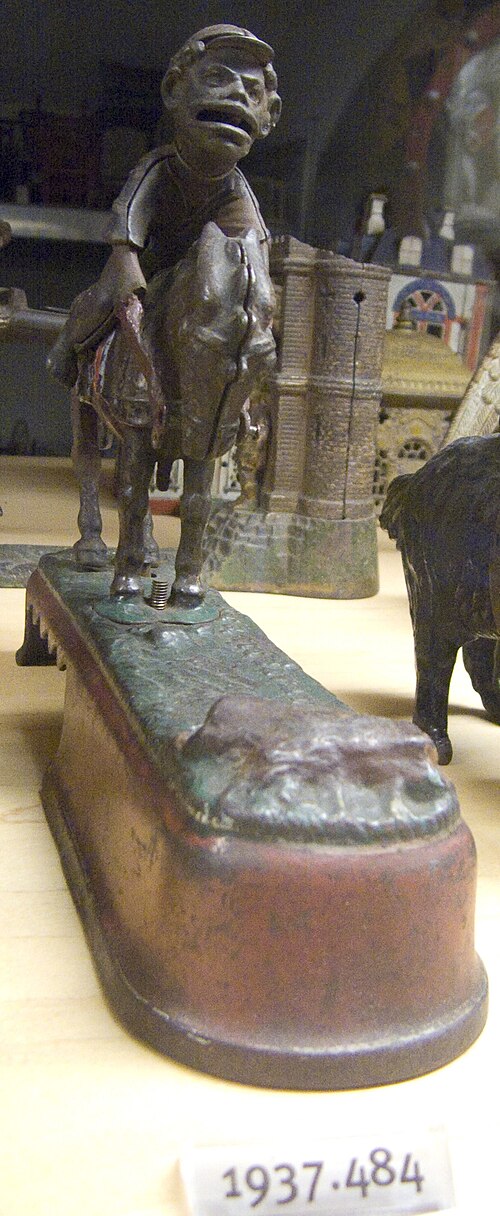
 Cast iron banks are one of the most approachable “serious” antique categories you can collect because they sit at the intersection of folk art, early advertising, and mechanical ingenuity. You’re not just buying a coin bank, you’re buying a piece of industrial-era design history.
When you’re evaluating one, first identify what type you’re dealing with. This matters because it heavily impacts value and desirability.
- Still banks: No moving parts, usually simple but often beautifully designed
- Mechanical banks: A lever or coin trigger creates motion (these often bring the highest prices)
- Building/novelty banks: Themed designs like houses, safes, animals, and everyday objects
Condition matters, but with cast iron you’re judging originality more than perfection. The most valuable banks typically retain their original paint, even if the paint shows wear. That “honest wear” is often a good sign.
Be careful with banks that look too clean or too glossy. Repainted banks can look impressive to newer collectors, but many experienced buyers avoid them because repainting can hide repairs, cracks, or replaced parts. Original paint usually shows natural wear on raised edges and handling points, with darker oxidation tucked into crevices. Newer paint often looks too even and too uniform.
Next, inspect the casting and hardware closely. Hairline cracks show up most often around stress points like hinges, coin slots, screw holes, and corners. Many banks were forced open over the years, so damage around the base plate is common.
You should also verify that everything matches: the trap door, latch, screws, and base plate. Replacement screws, incorrect plates, or missing internal parts will reduce value significantly, especially on mechanical banks where completeness is everything.
Finally, maker details and provenance can push a bank into a different tier. Some foundries and names, like J. & E. Stevens, are heavily collected, and many famous banks have well-known variations. If you want to level up fast, study auction results and reference guides so you can compare paint patterns, casting details, and hardware layouts.
When you buy, pay for originality, not shine. The bank that looks a bit worn but untouched often holds value far better than the glossy repainted one.
Four Sales is the leading estate sale company in Virginia, DC and Maryland. For the past 40+ years, Four Sales has conducted over 3,000 estate sales in Virginia, DC and Maryland. Four Sales estate sales headquarters is in Alexandria, Virginia with regional offices in Charlottesville, Virginia and Annapolis, Maryland.